
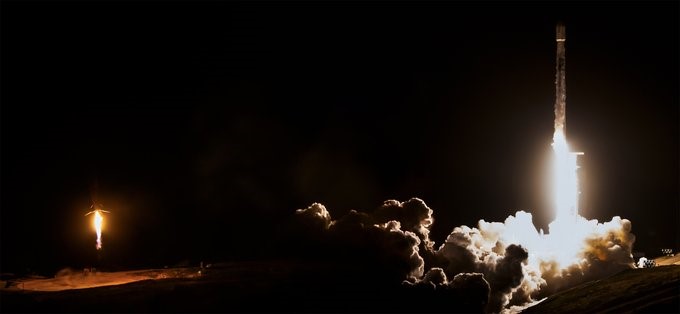
Sweden has taken a significant step into the space domain with the launch of its first national military reconnaissance satellite, marking a major expansion of its defense and intelligence capabilities. The satellite was launched aboard a Falcon 9 rocket by SpaceX from Vandenberg Space Force Base in California, reaching low Earth orbit and becoming operational after a rapid development timeline that far outpaced earlier plans targeting 2030.
The satellite, built by Planet Labs, provides Sweden with an independent ability to collect high-resolution imagery for military intelligence. Until now, the Swedish Armed Forces relied on data from allies or commercial providers. With this launch, Sweden gains direct control over an always-available intelligence asset capable of monitoring distant regions and detecting potential threats, including troop movements and other military activities.
Rear Admiral Anders Sundeman described the development as a major capability boost. The satellite enhances Sweden’s ability to observe areas that have historically been difficult to monitor, such as the Arctic, while also expanding surveillance reach into regions of strategic concern. This new capability is particularly relevant as Sweden adjusts to its role within NATO, where its operational focus now extends to the alliance’s external borders.
The launch is the first step in a broader plan to deploy a constellation of approximately ten satellites within the next two years. Although a dozen satellites alone will not provide continuous global coverage, they will significantly strengthen Sweden’s intelligence capacity when combined with systems operated by other NATO members. Each satellite orbits the Earth roughly every 90 minutes, enabling regular but not constant observation of key areas.
The program has progressed at an unusually fast pace, driven by urgent defense needs. Sweden’s evolving military posture—including longer-range weapons systems—requires more advanced and far-reaching intelligence capabilities. The rapid deployment was made possible through close coordination between Swedish defense institutions and the use of commercial partners for both manufacturing and launch services, prioritizing speed and reliability over developing a fully domestic space industry.
Operational control of the satellite will initially be supported by Planet Labs, with Sweden gradually transitioning to full control through a newly established Space Operations Center at Air Force Headquarters in Uppsala. This center will manage satellite operations, develop space situational awareness, and integrate intelligence into Sweden’s broader military framework. Satellite imagery will be distributed across different branches of the armed forces to support decision-making and operational planning.
The satellite itself is relatively compact—about the size of a washing machine—and can be maneuvered to avoid collisions with space debris or other satellites. However, it does not carry any defensive or offensive capabilities. As Sundeman noted, while some nations are beginning to develop offensive systems in space, Sweden’s current focus remains on reconnaissance, surveillance, and intelligence gathering.
Beyond national defense, Sweden’s entry into space-based military operations contributes to NATO’s collective situational awareness. By adding its own reconnaissance assets to the alliance’s network, Sweden enhances the overall ability to detect, analyze, and respond to threats across regions such as the Baltic Sea, the Arctic, and beyond.







Leave a comment